Showing posts with label performance. Show all posts

Monday, August 5, 2013

Well Rested and Well Read


I have been silent for sometime now and you, my loyal readers, may have been wondering where I went.  Well I have been reading.  I like to take the summer, the nice weather and the long days to stretch out with a good book.  I read voraciously during the summer.  Books, articles, magazines, anything I can get my hands on!  I recently read an article in the New York Times Educational section about educating the children of India.  The article talks about the shortage of affordable and qualified teachers for the Indian public schools.  It then describes a system of recruiting and training mostly uneducated, poor, women to be trained specifically to teach in these educational settings.  The idea of specific training programs, apprenticeships if you will, for teachers seemed so innovative—and yet we have been here before.

We hear so often of the children who failed in school who go on to be super successful.  Bill Gates, Albert Einstein, Mark Zuckerberg, Todd Rose I could go on…
square-peg-my-story-and-what-it-means-for-raising-innovators-visionaries-and-out-of-the-box-thinkers-330.jpg
 leads me to another book I read this summer is called Square Peg, by Todd Rose.  In this autobiographical work, Rose speaks of his schooling growing up.  He recounts failure after failure in his school career until he ends up a drop out with a dead-end job.  Spoiler alert: (Eventually he realizes that he needs to advance his education in order to make a living for his growing family and he goes back to school.  After many years of hard work he is a successful Professor of Education at Harvard University, and an author of a very engaging book!) 

What do these women in India and Todd Rose have in common?  They each seemed to be on a fairly predictable path towards poverty and struggles but something helped to pull them from this trajectory and into a career of educating others.  Neither of them could have told you in their youth that they would be responsible teachers or professors, professionals or a role model to others.  They were, from an early age, on a trajectory towards failure until some large, unexpected, event threw them out of orbit.

How can we ensure that all children end up on a path like Dr. Rose?  How can we take these children at a young age and ensure success?  Do we risk pigeonholing children at a young age if we knock them off their orbits?  Can we see red flags or early predictors before these failures become reality?  Do we need to reevaluate our educational system to ensure more children end up on the successful path rather than the path of failure?  Should we revert back to an apprenticeship model?  Is there a way to identify children’s strengths earlier in life and allow them to focus on these areas?  Do we sell children short by only ‘generally’ educating them until they are 18 or would forcing them to focus earlier on make them miss out on the ability to flexibly shift later in life?  What is our goal of education?  What do we hope for children to accomplish at the end of middle school? High school? College?

As we start this year, like all years, with a clean slate, I think we need to take a lesson from ourselves in backwards design.  Let’s paint a picture of success and from there work backwards to make our portrait of success in an educated American child.   Let’s ask ourselves these questions about our schools, our classrooms, and our students.  Let’s make sure that Todd Rose or Bill Gates are not exceptions to the rule but true definitions of what it means to be educated in our classrooms.

Wednesday, February 6, 2013

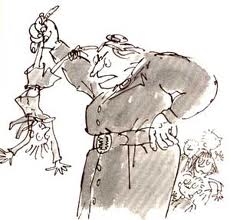
Lessons from The Trunchbull

My son and I are in the midst of a major Roald Dahl phase.  Dahl is a very dark author and reading his books together has been a blast, and has given the two of us a lot to discuss.  Our most recent foray was in the heart of Matilda.  Matilda is a particularly gifted student in Miss Honey's class.  Miss Honey is very caring, but most of the other adults in Matilda's life are not.  The principal in the school 'The Trunchbull' has some particularly stirring pearls of wisdom.


                 "I have never been able to understand why small children are so disgusting.  They are the             bane of my life.  They are like insects." she declares while sitting in Matilda's kindergarten class. "My idea of a   perfect school, Miss Honey, is one that has no children in it at all.  One of these days I shall start up a school like that.  I think it will be very successful."

When my six year old read this line he turned to me and said "A school with no children in it would just be a factory."

Now I could turn this blog post in many different directions.  A gushing parent tribute to my incredibly reflective kindergartner, an editorial about the value of children, but instead I want to think about what a school with no children would look like.  Would it indeed be a factory?

In the model of today's schools my son's gut reaction may be correct.  Ken Robinson creates a great image in one of his talks about the child on an assembly line where the only thing that really matters is the date of manufacture.  They are moved through the years like stages of production until they are stamped at the end with a seal of approval in the form of a diploma.  There are periodic 'inspections' from various factory workers and the overall product should look fairly similar to the one produced in the same box.

What if this weren't true.  What if a school with no children was a workshop?  What if the end product wasn't one in a box of nine but rather a unique piece of art like nothing ever seen.

This seems intimidating.  It seems impossible.  It may even seem too idealistic.  And perhaps all of these are true using the framework that we work within.  But what if this framework looked different?

Some of us have the ability to make these changes.  As school leaders we can reshape the way our schools look.  We can restructure our class groupings, subject areas, or even just the way we frame our assignments to our children.  What if you replaced one unit test with an unbounded project?  What would you see?

I don't know, it may be a disappointment and a waste of time but it may be just the thing that you need.  Maybe that kid who never cared about your class would open up and soar.  Perhaps that shy kid who never was able to connect would be able to mentor a neighbor in an area of strength.  You never know what your students may be able to accomplish unless they are given the chance to show you.

One year I had a student who was painfully shy.  It made me uncomfortable to ask her to speak because  the idea of putting two words together in front of her class was pure agony.  As one of the final assignments of the year I hosted an America Idolesque competition in my classroom.  The students all had to present some type of performance showing what they had learned about different types of rocks. We then had a voting process and the winner was chosen to present at a whole school assembly.  Well by now you probably have guessed that the student who won in our class was this same shy girl.  She stood uncomfortably in front of our classroom and quietly read the words to a song she had written.  No one could hear the words, but after her presentation she passed around the lyrics so we could all see them.  They were really fantastic, witty and smart.  Her peers voted that her song was the one that needed to be presented at the assembly but how was she going to do it?  We couldn't even hear her in our small classroom.  They brainstormed what to do.
"Well let's teach her how to sing loudly"
                                       "Picture the audience in their underwear"
"That never works..."
         "Wait, why don't we sing with her"                                 "We can't do that, those aren't the rules"
"Who made up the rules?"
                                             "Let's just change them"
The kids kept going on.  I am sure you can hear the conversation in your own head.  Eventually without any intervention from me, the students decided they all needed to learn the words--the song was too good not to be heard.  One boy offered a guitar, another offered to write out the chords for him.

These were kids I had never seen before.

I knew what they knew in math.  I knew their reading levels could predict their misunderstandings.  I even knew what they liked to do in their free time, but this was a side of them I had never seen.  Giving them an opportunity to just be authentic allowed them to take on new roles they had never taken on in my classroom before.  It may have looked like a waste of time to an outsider, but I knew differently.

They used problem solving, critical thinking, musical prowess, and so many more skills I didn't document.  This was true learning, and I had very little to do with it.  The end result wasn't an amazing performance.  I can't say the whole school stood demanding an encore.  There wouldn't have been any dramatic music in the scene in the movie--but those kids were so proud.

They were all beaming: the writer, director, musical accompanist and their teacher.  Although I didn't give them each an inspection stamp at the end, I could really see the value of their time and the beauty of their art.  The work they did in my class those few days couldn't have been done in a factory, only a workshop filled with chaos and failure, ingenuity and perseverance could have produced such a performance.