Showing posts with label creativity. Show all posts

Friday, April 26, 2013

You Changed the What?!?!?


We have a constant need to do better—or we should.  If we don’t try and do new things better than last year then we are not ‘good’ teachers.  We become stagnant in our work.  We become the washout of the school, the teacher no parent or kid wants to be subjected to for a whole year… 

It is your first year teaching fifth grade.  You have taught third grade for four years but you are now moving up in the world to fifth grade.  The last fifth grade teacher retired with much fanfare and many tears from adoring students and parents—and look at that here you are. 

The material you received from him was a jumbled mess.  You know there is a method to his madness, but you cannot for the life of you figure it out.  You do see the big file called “State Projects.”  Youknow about these state projects, they are famous, legendary.  Fifth graders have been completing them for centuries.  There are model projects in this folder from at least 10 different years!  As you plod through the planning of the year you realize a really cool way to integrate this years state project with your science unit.  ‘This is going to be so cool.’ You think to yourself.  In fact, it takes the project to a whole new level.  You spend months building it up in your head and in the minds of your students.  They cannot wait to start.  Finally, in February, you hand out the assignment, rubric, and timeline.  The students have to bring it home to review with their parents and bring it back with a signature that they all understand what is expected. 

Monday morning one student brings it back with a post-it note from his mother “I would really like to speak with you about this project.” The note says.  An email is waiting in your inbox from another parent about your ‘new idea.’  And yet another approaches you at pickup.  The message is the same from each of them:

How can you change this treasured tradition of the fifth grade project?

By now, I am sure you have a similar story from your own experience in mind.  Whether it is changing an assessment, book choice, unit of study, or routine I am sure you have heard people resistant to your change.  Change is uncomfortable, it is unsettling but yet we know we need to keep evolving to thrive in our jobs.

How can we reach a balance with this tension?  When do we need to drop what is comfortable for something new and challenging?  When do we need to maintain routine and structure for the sake of our classes and ourselves?

I think we need to ask ourselves the biggest question of ‘why?’

In the scenario I painted above the new teacher had a need that she was trying to meet.  She was entering a world of unknown trying to make sense for herself—to own the classroom she was about to guide.  Her need was strong and real and she wouldn’t have been able to teach the students well if she didn’t feel in control of the classroom material.  Had she just taken over the jumble of files her year would have been a jumble of lessons. 

Many new teachers starting out feel one of two things.  One new teacher needs to prove to herself and to those around her that she can ‘do it on her own.’  She wants to separate herself from the person who had been there before and prove that she is just as worthy of the position if not more.  She may abandon what has worked in the past for the sake of being ‘different, innovative, creative.’  The other new teacher clings on to what he has seen.  He anchors himself in the known even if he knows it isn’t was is best for his students.  He knows what he would like to do, but is uncomfortable making any changes for fear of failure.

As you can imagine, neither of these teachers are ideal.  As with almost everything in life we teachers need to balance.  We need to balance the old with the new, the innovative and the routine and most importantly we constantly need to be asking ourselves ‘Why am I really doing this?  Is it best for my students?’

So let’s go back to our new fifth grade teacher.  Was she wrong to change the project?  Is she expecting too much changing this beloved project too soon?

She needs to listen to the parents and understand that change is hard and uncomfortable but ultimately if she can answer the ‘why’ with confidence and compassion she is off to a successful start.

Tuesday, February 26, 2013

"Ish-ly Ever After"


Ish by Peter H. Reynolds


When I was younger I would have told you that I wasn't creative.  I was never very good at drawing and I have very little musical aptitude so as a child I could only label myself as "not creative."  I even had an art teacher who used to fix my work when I was finished to make it more accurate.

I recently had the pleasure to sit and observe an impressive early childhood classroom.  I spent most of my  observation focused on two boys.  One boy was sitting under the climbing structure with a shovel digging "the deepest hole ever," while his companion was filling the dirt from the hole into a red wagon.  There was a lot going on in that yard, children coming and going, fighting erupting and resolving but these two little boys kept on digging.  They were checking the depth of the hole against their shovel, responsibly collecting the dirt and taking turns when one got tired of his position.  At a certain point the digger declared he was 'done' (I presume the center of the earth was getting a little too warm) but the play had only begun.  The second had an idea.  "Lets get some water."
The mud was delicious. The rich dark liquid coated their hands, shirts, the wagon and even the patio.  The boys experimented with the way their new substance flew threw the air, stuck on different objects, and trickled down their arms.  "We can build pyramids like in Egypt." one said and then the rock collecting began.
This play continued until the mud hardened, the pyramids had been built (yes, in one day), and the boys were ready for a new adventure.
So you may ask 'is this learning?' 'where was the teacher?' 'what goals did they meet?'

What if I told you they were learning'ish.'  There is a wonderful book by Peter H. Reynolds called "Ish."  It is about a boy who loved to draw until his brother mocked him for the inaccuracies in his drawings.  He gave up drawing all together until his sister points out the "ish" quality of his work.  "Ramon felt light and energized.  Thinking ish-ly allowed his ideas to flow freely."

No one in this early childhood classroom was worried about the final product.  No one cared if the boys were dirty, or there was a hole in the ground, or if there was mud in the wagon.  The boys, like most five year olds, were naturally thinking ish-ly and their teachers were going along with it.

Thankfully, this scene is not unique to the school I was visiting.  Many early childhood teachers understand the value of "ish" thinking.  The products are not what is important, it is truly the process.  Students don't need to take home a cute project because they have spent the day really learning and growing.  There are a myriad of ways to document student learning and teachers can show this growth through storyboards, videos, anecdotal stories, and photographs.

I can say with confidence that most art teachers don't 'fix' their students' work.  Many early childhood teachers understand the value of process over product.  But what happens as children grow up?  One of my colleagues told me of a course he took on differentiated instruction where the professor lectured the entire time.  When asked about his method of teaching the professor replied "there is just too much to cover, I don't have time to differentiate."   What happens along the way?  How can we go from an open ended mud play to a two hour lecture and expect that each student is really learning the most he can learn? What is the developmentally appropriate way to teach a college age student?  Is this a question we even should be asking?  Shouldn't students know how to learn on their own by college?

When students enter the workplace they are often put back into the 'ish' zone.  Sure they are asked to complete tasks and perform the basics but it really is the 'ish' that will set them apart and lead them to success.  It is the out of the box and creative, projects and ideas that make a difference in life.  If these students haven't thought 'ish'-ly since they were six, it will be a lot more difficult to switch their thinking at twenty.  So how can we make room for the 'ish' in all of our classrooms?  How can we reward this thinking and creativity and "allow his ideas to flow freely?"

I won't tell you now that I am not a creative person.  It took me years to be able to see the creativity inside myself.  I was stuck in the mindset that creativity could only be seen through art or music.  Maybe during the poetry unit we did once a year or the creative writing essay that was worth 10 percent of my grade I could use that little bit of creativity I had.  But now, as an adult, in real life, I use my creativity every single day.  I hope that our students don't have to wait until they are adults to come to this realization.  Each and every one of our students should be able to live their lives "ishly ever after" no matter how their creativity manifests itself.


Wednesday, February 6, 2013

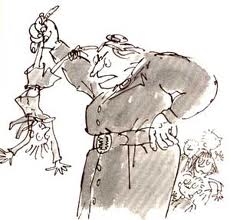
Lessons from The Trunchbull

My son and I are in the midst of a major Roald Dahl phase.  Dahl is a very dark author and reading his books together has been a blast, and has given the two of us a lot to discuss.  Our most recent foray was in the heart of Matilda.  Matilda is a particularly gifted student in Miss Honey's class.  Miss Honey is very caring, but most of the other adults in Matilda's life are not.  The principal in the school 'The Trunchbull' has some particularly stirring pearls of wisdom.


                 "I have never been able to understand why small children are so disgusting.  They are the             bane of my life.  They are like insects." she declares while sitting in Matilda's kindergarten class. "My idea of a   perfect school, Miss Honey, is one that has no children in it at all.  One of these days I shall start up a school like that.  I think it will be very successful."

When my six year old read this line he turned to me and said "A school with no children in it would just be a factory."

Now I could turn this blog post in many different directions.  A gushing parent tribute to my incredibly reflective kindergartner, an editorial about the value of children, but instead I want to think about what a school with no children would look like.  Would it indeed be a factory?

In the model of today's schools my son's gut reaction may be correct.  Ken Robinson creates a great image in one of his talks about the child on an assembly line where the only thing that really matters is the date of manufacture.  They are moved through the years like stages of production until they are stamped at the end with a seal of approval in the form of a diploma.  There are periodic 'inspections' from various factory workers and the overall product should look fairly similar to the one produced in the same box.

What if this weren't true.  What if a school with no children was a workshop?  What if the end product wasn't one in a box of nine but rather a unique piece of art like nothing ever seen.

This seems intimidating.  It seems impossible.  It may even seem too idealistic.  And perhaps all of these are true using the framework that we work within.  But what if this framework looked different?

Some of us have the ability to make these changes.  As school leaders we can reshape the way our schools look.  We can restructure our class groupings, subject areas, or even just the way we frame our assignments to our children.  What if you replaced one unit test with an unbounded project?  What would you see?

I don't know, it may be a disappointment and a waste of time but it may be just the thing that you need.  Maybe that kid who never cared about your class would open up and soar.  Perhaps that shy kid who never was able to connect would be able to mentor a neighbor in an area of strength.  You never know what your students may be able to accomplish unless they are given the chance to show you.

One year I had a student who was painfully shy.  It made me uncomfortable to ask her to speak because  the idea of putting two words together in front of her class was pure agony.  As one of the final assignments of the year I hosted an America Idolesque competition in my classroom.  The students all had to present some type of performance showing what they had learned about different types of rocks. We then had a voting process and the winner was chosen to present at a whole school assembly.  Well by now you probably have guessed that the student who won in our class was this same shy girl.  She stood uncomfortably in front of our classroom and quietly read the words to a song she had written.  No one could hear the words, but after her presentation she passed around the lyrics so we could all see them.  They were really fantastic, witty and smart.  Her peers voted that her song was the one that needed to be presented at the assembly but how was she going to do it?  We couldn't even hear her in our small classroom.  They brainstormed what to do.
"Well let's teach her how to sing loudly"
                                       "Picture the audience in their underwear"
"That never works..."
         "Wait, why don't we sing with her"                                 "We can't do that, those aren't the rules"
"Who made up the rules?"
                                             "Let's just change them"
The kids kept going on.  I am sure you can hear the conversation in your own head.  Eventually without any intervention from me, the students decided they all needed to learn the words--the song was too good not to be heard.  One boy offered a guitar, another offered to write out the chords for him.

These were kids I had never seen before.

I knew what they knew in math.  I knew their reading levels could predict their misunderstandings.  I even knew what they liked to do in their free time, but this was a side of them I had never seen.  Giving them an opportunity to just be authentic allowed them to take on new roles they had never taken on in my classroom before.  It may have looked like a waste of time to an outsider, but I knew differently.

They used problem solving, critical thinking, musical prowess, and so many more skills I didn't document.  This was true learning, and I had very little to do with it.  The end result wasn't an amazing performance.  I can't say the whole school stood demanding an encore.  There wouldn't have been any dramatic music in the scene in the movie--but those kids were so proud.

They were all beaming: the writer, director, musical accompanist and their teacher.  Although I didn't give them each an inspection stamp at the end, I could really see the value of their time and the beauty of their art.  The work they did in my class those few days couldn't have been done in a factory, only a workshop filled with chaos and failure, ingenuity and perseverance could have produced such a performance.