Tuesday, February 26, 2013

"Ish-ly Ever After"


Ish by Peter H. Reynolds


When I was younger I would have told you that I wasn't creative.  I was never very good at drawing and I have very little musical aptitude so as a child I could only label myself as "not creative."  I even had an art teacher who used to fix my work when I was finished to make it more accurate.

I recently had the pleasure to sit and observe an impressive early childhood classroom.  I spent most of my  observation focused on two boys.  One boy was sitting under the climbing structure with a shovel digging "the deepest hole ever," while his companion was filling the dirt from the hole into a red wagon.  There was a lot going on in that yard, children coming and going, fighting erupting and resolving but these two little boys kept on digging.  They were checking the depth of the hole against their shovel, responsibly collecting the dirt and taking turns when one got tired of his position.  At a certain point the digger declared he was 'done' (I presume the center of the earth was getting a little too warm) but the play had only begun.  The second had an idea.  "Lets get some water."
The mud was delicious. The rich dark liquid coated their hands, shirts, the wagon and even the patio.  The boys experimented with the way their new substance flew threw the air, stuck on different objects, and trickled down their arms.  "We can build pyramids like in Egypt." one said and then the rock collecting began.
This play continued until the mud hardened, the pyramids had been built (yes, in one day), and the boys were ready for a new adventure.
So you may ask 'is this learning?' 'where was the teacher?' 'what goals did they meet?'

What if I told you they were learning'ish.'  There is a wonderful book by Peter H. Reynolds called "Ish."  It is about a boy who loved to draw until his brother mocked him for the inaccuracies in his drawings.  He gave up drawing all together until his sister points out the "ish" quality of his work.  "Ramon felt light and energized.  Thinking ish-ly allowed his ideas to flow freely."

No one in this early childhood classroom was worried about the final product.  No one cared if the boys were dirty, or there was a hole in the ground, or if there was mud in the wagon.  The boys, like most five year olds, were naturally thinking ish-ly and their teachers were going along with it.

Thankfully, this scene is not unique to the school I was visiting.  Many early childhood teachers understand the value of "ish" thinking.  The products are not what is important, it is truly the process.  Students don't need to take home a cute project because they have spent the day really learning and growing.  There are a myriad of ways to document student learning and teachers can show this growth through storyboards, videos, anecdotal stories, and photographs.

I can say with confidence that most art teachers don't 'fix' their students' work.  Many early childhood teachers understand the value of process over product.  But what happens as children grow up?  One of my colleagues told me of a course he took on differentiated instruction where the professor lectured the entire time.  When asked about his method of teaching the professor replied "there is just too much to cover, I don't have time to differentiate."   What happens along the way?  How can we go from an open ended mud play to a two hour lecture and expect that each student is really learning the most he can learn? What is the developmentally appropriate way to teach a college age student?  Is this a question we even should be asking?  Shouldn't students know how to learn on their own by college?

When students enter the workplace they are often put back into the 'ish' zone.  Sure they are asked to complete tasks and perform the basics but it really is the 'ish' that will set them apart and lead them to success.  It is the out of the box and creative, projects and ideas that make a difference in life.  If these students haven't thought 'ish'-ly since they were six, it will be a lot more difficult to switch their thinking at twenty.  So how can we make room for the 'ish' in all of our classrooms?  How can we reward this thinking and creativity and "allow his ideas to flow freely?"

I won't tell you now that I am not a creative person.  It took me years to be able to see the creativity inside myself.  I was stuck in the mindset that creativity could only be seen through art or music.  Maybe during the poetry unit we did once a year or the creative writing essay that was worth 10 percent of my grade I could use that little bit of creativity I had.  But now, as an adult, in real life, I use my creativity every single day.  I hope that our students don't have to wait until they are adults to come to this realization.  Each and every one of our students should be able to live their lives "ishly ever after" no matter how their creativity manifests itself.



Wednesday, February 6, 2013

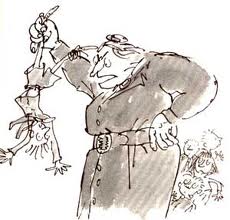
Lessons from The Trunchbull

My son and I are in the midst of a major Roald Dahl phase.  Dahl is a very dark author and reading his books together has been a blast, and has given the two of us a lot to discuss.  Our most recent foray was in the heart of Matilda.  Matilda is a particularly gifted student in Miss Honey's class.  Miss Honey is very caring, but most of the other adults in Matilda's life are not.  The principal in the school 'The Trunchbull' has some particularly stirring pearls of wisdom.


                 "I have never been able to understand why small children are so disgusting.  They are the             bane of my life.  They are like insects." she declares while sitting in Matilda's kindergarten class. "My idea of a   perfect school, Miss Honey, is one that has no children in it at all.  One of these days I shall start up a school like that.  I think it will be very successful."

When my six year old read this line he turned to me and said "A school with no children in it would just be a factory."

Now I could turn this blog post in many different directions.  A gushing parent tribute to my incredibly reflective kindergartner, an editorial about the value of children, but instead I want to think about what a school with no children would look like.  Would it indeed be a factory?

In the model of today's schools my son's gut reaction may be correct.  Ken Robinson creates a great image in one of his talks about the child on an assembly line where the only thing that really matters is the date of manufacture.  They are moved through the years like stages of production until they are stamped at the end with a seal of approval in the form of a diploma.  There are periodic 'inspections' from various factory workers and the overall product should look fairly similar to the one produced in the same box.

What if this weren't true.  What if a school with no children was a workshop?  What if the end product wasn't one in a box of nine but rather a unique piece of art like nothing ever seen.

This seems intimidating.  It seems impossible.  It may even seem too idealistic.  And perhaps all of these are true using the framework that we work within.  But what if this framework looked different?

Some of us have the ability to make these changes.  As school leaders we can reshape the way our schools look.  We can restructure our class groupings, subject areas, or even just the way we frame our assignments to our children.  What if you replaced one unit test with an unbounded project?  What would you see?

I don't know, it may be a disappointment and a waste of time but it may be just the thing that you need.  Maybe that kid who never cared about your class would open up and soar.  Perhaps that shy kid who never was able to connect would be able to mentor a neighbor in an area of strength.  You never know what your students may be able to accomplish unless they are given the chance to show you.

One year I had a student who was painfully shy.  It made me uncomfortable to ask her to speak because  the idea of putting two words together in front of her class was pure agony.  As one of the final assignments of the year I hosted an America Idolesque competition in my classroom.  The students all had to present some type of performance showing what they had learned about different types of rocks. We then had a voting process and the winner was chosen to present at a whole school assembly.  Well by now you probably have guessed that the student who won in our class was this same shy girl.  She stood uncomfortably in front of our classroom and quietly read the words to a song she had written.  No one could hear the words, but after her presentation she passed around the lyrics so we could all see them.  They were really fantastic, witty and smart.  Her peers voted that her song was the one that needed to be presented at the assembly but how was she going to do it?  We couldn't even hear her in our small classroom.  They brainstormed what to do.
"Well let's teach her how to sing loudly"
                                       "Picture the audience in their underwear"
"That never works..."
         "Wait, why don't we sing with her"                                 "We can't do that, those aren't the rules"
"Who made up the rules?"
                                             "Let's just change them"
The kids kept going on.  I am sure you can hear the conversation in your own head.  Eventually without any intervention from me, the students decided they all needed to learn the words--the song was too good not to be heard.  One boy offered a guitar, another offered to write out the chords for him.

These were kids I had never seen before.

I knew what they knew in math.  I knew their reading levels could predict their misunderstandings.  I even knew what they liked to do in their free time, but this was a side of them I had never seen.  Giving them an opportunity to just be authentic allowed them to take on new roles they had never taken on in my classroom before.  It may have looked like a waste of time to an outsider, but I knew differently.

They used problem solving, critical thinking, musical prowess, and so many more skills I didn't document.  This was true learning, and I had very little to do with it.  The end result wasn't an amazing performance.  I can't say the whole school stood demanding an encore.  There wouldn't have been any dramatic music in the scene in the movie--but those kids were so proud.

They were all beaming: the writer, director, musical accompanist and their teacher.  Although I didn't give them each an inspection stamp at the end, I could really see the value of their time and the beauty of their art.  The work they did in my class those few days couldn't have been done in a factory, only a workshop filled with chaos and failure, ingenuity and perseverance could have produced such a performance.


Friday, January 25, 2013

What are we assessing?


I just spoke to a teacher about her assessment practices in her middle school classroom.  "How can I assess my students?" she said "I can't place judgement on their work, only they know if they were putting in their full effort or not."  She went on further to explain that "I don't want to define them, they need to learn to measure their own success."

The whole process of grading is so emotional.  It is as if we as people are being judged on our grades, on our test scores, on how well we performed on this one particular test.  Standardized tests have been defining our schools for many years.  We need a way to make sure all fourth graders are achieving at the same level, that no one is falling through the cracks.  But have we gone too far?  Have we reached a tipping point when city budgets are set based on eight year old's scores on a test?

Is there a way to assure that all of our students are achieving without pitting them or ourselves against one another?  Is there a way to help our students learn the value of work without imposing our own definitions of success on them?  Can we assure that all children are learning and growing without making the stakes so high that the success defines their entire being?

I think there is room for a healthy voice in this conversation.  We all strive to be acknowledged, we all need feedback and we all want to know that we have accomplished something.  I firmly believe in authentic assessment.  I think that students, just like adults, need to know when they have accomplished something and how they were successful.  We can give students feedback in an authentic way, judging their work over time and their consolidation of information.  Looking at drafts of work and portfolios of different pieces over time are two ways to allow students to show their own success over time.  Presenting a student with a rubric that shows the criteria we are looking for allows our students to know what they can do to be successful.

Translating this idea to a large scale is where the problem comes in.  It is much easier for a machine to grade standardized tests than to evaluate the progress of a portfolio over time.  This is why we need to trust teachers.  We need to properly prepare  teachers, support them, and trust that they know how to truly assess their own students.  If we know that teachers are properly prepared to give and grade assessments then we can rest assured that our students are getting the proper feedback on their own learning, teachers understand where they need to teach for the children to grow and we can be assured that everyone is on track.


Monday, January 14, 2013

Why Haven't You Posted?

So you may have noticed that I haven't posted in awhile, or you may not have since I don't have that many followers--yet.

The person who definitely noticed was my husband (shout-out to my very first follower!).  He keeps reminding me that I haven't blogged in a while, as if I didn't know.  I know better than anyone that this feed has remained blank, so why don't I just do it already?  The simple answer is writers block.

Sometimes the ideas are just not flowing.  My assignment seems simple, write a few paragraphs about teaching or learning, or learning to teach, and press 'publish.'

Thinking about this prohibitive writers block sent me straight back to high school.  In high school I had on average an essay a week that I needed to write. Sometimes the ideas just flowed out of me and sometimes they did not.  As a teacher I still think about that student who is struggling to express herself through my assignment.  How can I achieve a true level of authenticity in my assessment of my students?

I want to know if my entire class has read and understood the novel we just finished, so I assign an essay.  This sounds pretty typical, but is there a better way?  There will always be the student who has read and understood the piece but just cannot get motivated to write about it.  So for her, what am I truly assessing with this assignment?  Does a different assignment assess my goals for her more accurately?

In schools we tread the line between real life learning and a false construct of the classroom.  We want our students to be responsible, motivated and have followthrough even when they are not feeling 'it' but on the other hand we don't want students to complete an assignment purely because 'I said so.'

As I struggle with the ideas of alternative assessments, choices, and authentic accountability I am constantly asking myself "How will my students use this skill in their real lives."  I don't want my classroom to be something my students have to navigate purely because I have set up goals and expectations for them.  I want my students to take everything they have learned in my class and bring it to the real world.

So I ask myself, how can I teach my students to get over their own 'writer's block' without forcing them to write a piece merely to please me?


Thursday, December 20, 2012

Teaching the Teachers

This blogpost I wrote, originally appeared on edutopia.org on November 21,2012. It can be found here: http://www.edutopia.org/blog/teach-the-teachers-shira-loewenstein


You've been teaching for five years, and you love every part of it. You love the kids, your colleagues -- well -- you love teaching. The parents are happy, the kids learn, but you’re getting an "itch." School isn't as exciting as it used to be. The routines are becoming routine, and you know what the kids are going to get stuck on, push back at, get excited by -- nothing is new anymore.

You are not alone.

Should you pursue something else? Get on the track to become an administrator? Go back to grad school? What will bring that extra excitement back to your job? What will challenge you and, indeed, make every day an intellectual challenge? Would you want to stay if someone were pushing you to get better? If they were really challenging you to think about your practice and grow as an educator?

Channeling Your Expertise
Have you ever thought about teaching teaching? No, that wasn't a typo; it was a suggestion. You can become the next teacher of teachers and offer what you have learned to the newest members of the profession. There is no such thing as a "born teacher" or a "natural."

Author and teacher education expert Sharon Feiman-Nemser summed up concerns of new teachers nicely in What New Teachers Need to Learn, a 2003 article in Educational Leadership:

For the novice, the questions are unending: What am I supposed to teach? How will my students be tested? What will their test scores say about me as a teacher? What does the principal expect? Am I supposed to keep my students quiet, or do my colleagues understand that engaged learning sometimes means messy classrooms and active students? And after the first weeks of school, how can I find out what my students really know, deal with their diverse learning needs, and ensure that everyone is learning?
Teaching is a craft -- an art form -- that needs to be practiced and perfected. You know that new teachers don't know everything they need to thrive in your school -- even if they are really bright and come from a great graduate program. You have spent the past few years learning from your mistakes, reflecting on your practice, and perhaps now you are ready to help someone else.

Where to Begin as a Mentor
The first thing to do is look around your school. Is there a formal mentoring program going on? Do mentors meet regularly to talk about their mentoring practice? If so, you should join this community. Ask if you can become a regular at these meetings to learn more about mentoring from these mentors.

If your school doesn't have a mentoring program, you can start thinking about how to create one. Post a notice to your colleagues to see if anyone wants to be part of a book group with you. Begin the group by reading Beyond Mentoring by Jon Saphier or Coaching Classroom Instruction by Robert Marzano. Once you are acquainted with some of the basic principles of mentoring and coaching, you can start by observing one another and giving each other feedback.

Opening Your Classroom to Mentees
Now that you feel like this mentoring thing really is for you and you're ready to take the next leap, reach out to a local university. See what mentor training opportunities they have and how you can become involved. Your classroom may soon become a host classroom for new teachers, and you will be a mentor.

To become a teacher of teachers, or a mentor, you do not need to leave the classroom. You don't have to forgo the things you love; you are just adding another layer onto the teaching -- meta-teaching. This new challenge will help you think about your own practice. Why do you turn off the lights to get kids quiet? Is there a more effective way? Is there a different approach? Having another person observe your classroom regularly and question your decisions will help you grow in your own practice.

Becoming a mentor gives you a new peer group of other mentors and novice teachers. There is an entire world of mentoring, a ladder of professional growth. This field of new teacher support must continue growing to ensure that the caliber of our schools continues to grow.

Growing Within Your Job
Ultimately, the students need skilled teachers guiding them. As a skilled and proficient educator, you can't teach all of them every year, but you can teach their teachers. You can ensure that the teacher next door is thinking about his practice in a thoughtful manner. You can say with confidence that you know your kids will be going on to a reflective teacher -- if you are part of their teacher's education.

Graduate programs are always looking for skilled, thoughtful, reflective practitioners to open their classrooms to the new teachers entering the field. There are so many talented teachers who leave the field when they get that "itch," but you don't need to be one of them. You can continue to learn and grow within your current job, and help a novice learn as well. If you love teaching, why give that up for something else? Just start teaching the teachers.

What have you learned from a novice teacher that has helped improve your practice? What were some of the surprises you experienced taking on the role of mentor?

Tuesday, December 18, 2012

My Child is a Genius

Parents rarely tell us straight out that their son/daughter is a genius, but many of them believe it. Teachers get glimpses of this by the comments we hear. "Johnny says he already knows much of what you are teaching." Or " Sam said the most amazing thing today--I can't believe he is only five." In general parents know their children really well, so why do so many think their children are geniuses when "less than one quarter of one percent" ( http://www.iqtestexperts.com/making-genius.php) of humans are ACTUALLY considered to be geniuses?

I think the answer is simple, children are amazing. The capacity of children to understand their world, learn new information, and produce creative output is astounding. Parents realize this, but sometimes as teachers we can become numb.

When we see forty eleven year olds all day every day we tend to look for commonalities. How can I group these kids, what misunderstandings will this group have, what will allow me as one person to teach all of these kids? We are always looking for "developmental levels" or " problems that kids have every year" but we must remember to take a step back and remember the amazing 'genius' that each individual child has.

These children might not all be technical geniuses, but the fact that they are walking, talking, thinking, and innovating is truly amazing. Parents may not realize that the behavior they see at home really is typical of eight year olds, but they do see how amazing their eight year old truly is. As teachers we can learn from a parents definition of 'genius' and remember how amazing the human child really is.

Sunday, November 4, 2012

Who is Flying the Plane


Somewhere over Nebraska my plane began to experience serious turbulence.  It was like being on a rollercoaster in the sky.  Being the nervous traveler that I am, I thought to myself “It is a good thing that every commercial pilot needs to go through many hours of training before they become licensed to fly these planes.”  But what if that wasn’t required.  What if pilots were in such demand that we hired ‘really smart people who were good with buttons’ straight out of college?  Would you want to ride on that plane?
All too often we put our children in classrooms with ‘really smart people out of college who are great with children.’  They have no training or support, and many of them are destined to crash and burn. 
So what can we, as school leaders do to make sure that these new teachers succeed?  As a field we first need to acknowledge that teaching is truly a craft.  It is not merely a set of skills, tricks, and techniques that can be taught in a week.  No one was ‘born’ a teacher. Teaching is truly an art cultivated over many years through practice, thoughtfulness and deep self-reflection. 
We must set up systems in our schools to develop and cultivate new talent in the field. New teacher induction begins even before a teacher is hired.  Administrators need to be planful about how we hire and how we place a new teacher.  We realize that a new teacher is not seasoned or adept at their new position just because they have a teaching degree.  The number of classes, size of classes, and the specific children placed in a class are all need to be strategically chosen to allow for the success of both the new teacher and the success of the students.  All too often new teachers are given the most challenging classes with students who are struggling to learn.  Would you rather be with that new pilot on a 14 hour flight in the middle of a snowstorm or on the Boston to New York shuttle on a balmy July morning?  We tend to think the stakes are lower with our children in a classroom, but if your child were flying in that classroom with an ill equipped and ill supported teacher, you might feel a little differently.
Through the Yeshiva University School Partnership we have been able to develop systems of support for the new teachers in our classrooms.  Our New Teacher Induction Program currently works with five schools around the country to do just this.  The schools have partnered with our team to help develop systems to support the new teachers they employ.  The Institute works with the veterans, administrators, and new teachers to ensure that this support is sufficient to meet the needs of the new teachers.
When a new teacher walks in to the school there should be a plan to help him adjust to the new environment.  Where do I park? What do I wear? How do I order supplies? What are the students supposed to call me? Are just some of the questions that a new teacher doesn’t know the answers to when he first walks in to a new school.  This doesn’t even begin to address the issues of what do I teach, and what is the tone I set with parents. 
Once the new teachers feel some level of comfort with the school culture and the daily expectations, then comes the time for the serious work.  Each new teacher needs a mentor—a veteran teacher who can reflect on his/her own practice and help the new teacher learn to do the same.  The mentor is a new teacher’s guide to the complex thinking and planning behind what goes on in a classroom.  These two teachers need to build a relationship where they can learn from one another and each hone their individual craft.  Through the New Teacher Induction Program each new teacher in our participating schools receives a one-on one mentor to help him/her through these challenges.
The new teachers need to be able to explore their role in the school with other new teachers.  They need to feel a comfort in sharing their doubts and reservations with colleagues at a similar level of professional development.  Each new teacher needs to have an audience of colleagues who can truly appreciate a new success and who understand how to help him recover from a failure.  We have seen that schools that setup new teacher study groups, a network of new teachers, led by a veteran teacher have helped new teachers to deal with the common struggles they face as a cohort.   Camaraderie is what keeps teachers vibrant, dynamic, and ever learning.
Our teachers are the most reliable variable in predicting the success of our students.  Countless studies have shown unmistakable correlation between the effectiveness of teacher instruction and the accomplishments of their students.  Every student is going to have a new teacher at some point in his/her schooling.  That new teacher is given the invaluable task of guiding that child on the road to success for an entire year.  We need to be confident that our new teachers will have all the resources they need to ensure a smooth ride for both the teacher and the student in that first year.   Next year, the YU School Partnership will be partnering with 15 schools on this important endeavor.